
Introduction
The era of digital business is driving tectonic IT shifts toward process automation, agile cloud- and mobile-first application development, continuous integration and delivery, and the assimilation of IT operations into more efficient DevOps organizations, among others. Leading enterprises now seek an ongoing transformative approach: one that exploits these tectonic IT shifts, automates the delivery of customer value, and crafts new and unique competitive advantages over rivals.
The 451 Take
Details
Moreover, the exponential growth of IT innovations like container- and microservices-based applications, artificial intelligence and machine learning, and IoT add even more complexity. To cope, IT planners and operators must adapt and augment IT strategy and operations. Many now seek new means to manage and integrate their IT tools at hand, and augment them with technology to automate as many IT operations as possible, while unifying across complex hybrid IT ecosystems.
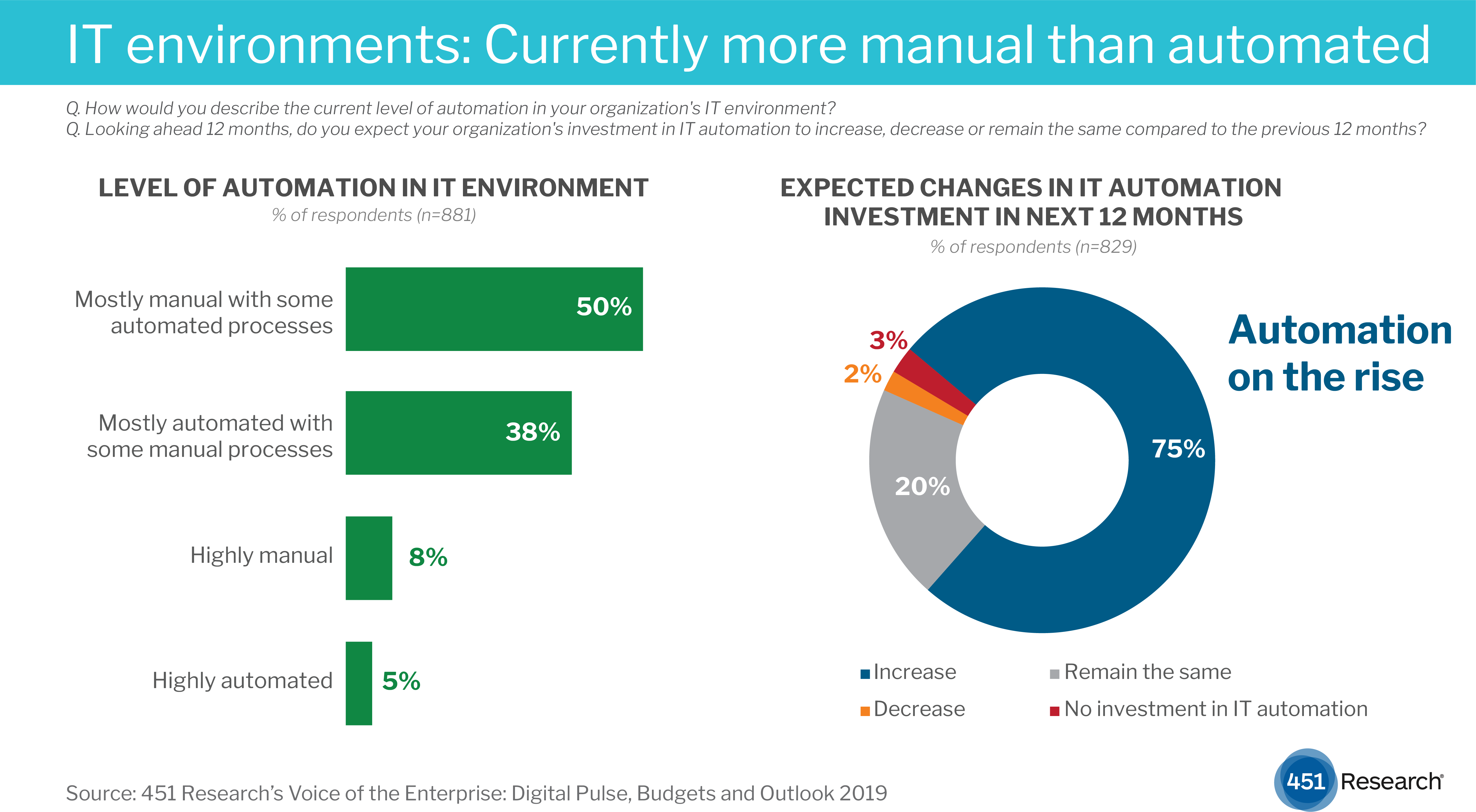
Many enterprise still lag. Figure 1 illustrates survey results of business and IT decision makers who were asked about their current and expected future automation efforts. Of the 881 respondents, 50% stated that automation in their IT environment is mostly manual with some automated processes; 75% say they expect IT automation to increase in the next 12 months.
IT automation has been underway for a number of years. Continuous integration and continuous delivery (CI/CD) automates the fruits of agile efforts, and provides the backbone for DevOps strategy. Application performance management (APM) continuously monitors performance and availability to maintain the required levels of service. And emerging AIOps uses analytics and machine-learning intelligence to analyze data collected from IT infrastructure to identify and react to anomalies in real time. These are all evolutionary and valuable. However, to enable IT infrastructure agility in the digital era, two – now mostly separate – technologies must come together within a uniform framework: digital automation platforms (DAPs) and hybrid integration platforms (HIPs).
A DAP is a set of tools and resources structured within a uniform framework to enable developers to rapidly design, prototype, develop, deploy, manage and monitor process-oriented applications. They compose rather than code applications, and are able to automate simple task-related workflows, dynamic unstructured collaborative activity streams, and even highly structured cross-functional IT and enterprise processes. HIPs represent the next generation of integration platform-as-a-service (iPaaS) technology to enable data exchange and interoperability across distributed and disparate on-premises infrastructure, software, cloud services, mobile devices and things that now compose modern hybrid IT architecture.
DAP and HIP technologies are converging in the world of IT operations, gradually enabling the unified IT operations framework needed to enable IT infrastructure agility and automation effectiveness in the digital business era. This will be the topic of a moderated panel discussion at 451 Research's Hosting & Cloud Transformation Summit (HCTS) 2019.

Carl leads 451 Research's coverage of integration and process management technologies in hybrid cloud architecture, as well as how hybrid IT affects business strategy and operations. The markets covered in his research include enterprise architecture management (EAM) tools, hybrid cloud integration technology (including iPaaS and API management) and business process management (BPM) software.

Jeremy Korn is a Senior Research Associate at 451 Research. He graduated from Brown University with a BA in Biology and East Asian Studies and received

Keith Dawson is a principal analyst in 451 Research's Customer Experience & Commerce practice, primarily covering marketing technology. Keith has been covering the intersection of communications and enterprise software for 25 years, mainly looking at how to influence and optimize the customer experience.